


Hey everyone, Wallysson here.
The site was called pokemontcgmg.com.br, and we lost the domain.
I went looking for it to write this article. The Wayback Machine has it online from May 2013 to April 2018, and nothing after that. The Liga TCMG page on Facebook is still up, and what lands there today comes from what we post on Instagram. The name survived. The site did not.
Then I opened that last capture, from April 14, 2018, and I was genuinely startled by how much we had built. The whole menu is still there: Deck Analysis, Card of the Week, Hall of Fame, Reports, How to Beat, Pokémon 101, Rules. There was even a Meta! PodCast. There was a BH Ranking with the current season, 2017, 2016 and 2015, a points history for each one, League Cup results split into Spring Series and Winter Series. There was an "About Us" and a TCMG Box. There was even a login.
None of that exists anymore. And what we were doing there, with no tooling at all, was the metagame of the entire country in a Google Doc, by hand, tournament by tournament. I built the ranking with help from Leozinho, the living legend. Two guys in a spreadsheet, counting point by point.
And then I clicked on the BH Ranking for 2015 to see if it still loaded. It loaded.
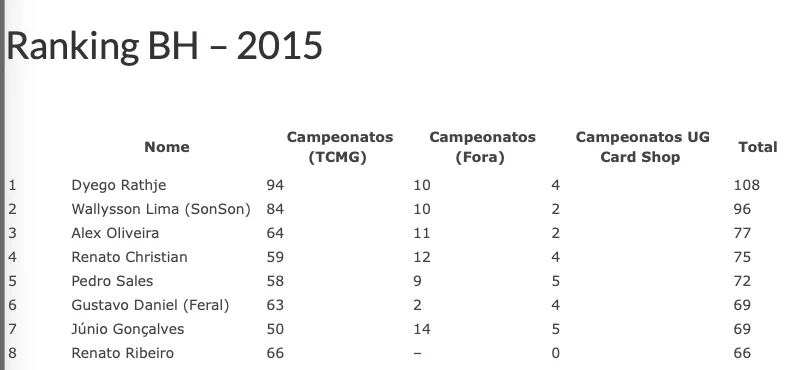
First place: Dyego Rathje, 108 points. Second: Wallysson Lima (SonSon), 96.
Yesterday, August 31, 2026, the ranking on this site closed its first season.
First place is the same guy.
Eleven years separate those two titles, and in between them there is a lost domain and a piece of our scene's history that went with it: tournament results, articles, who played what, who won. A site that spent five years online, erased because a domain expired.
So when I say TCMG Top Cut is a second attempt, that is literally what I mean: the idea is thirteen years old. What changed is the tooling.
This article is about that tooling: where it came from, what it can already do, what is still missing, and the invitation for you to join the next season.
It came back inside a work challenge
TCMG Top Cut was not born from a business plan. It was born from an internal challenge at my job: use Ubersuggest, the SEO tool I work with every day, to actually learn by building a site from scratch. Not a sample site: a real one, competing in search with everybody else.
I did not have to think about the topic for a single minute. I already knew which site I wanted to build again.
And there is a coincidence I only noticed now, while writing this. The last record of the old site in the Wayback Machine is April 14, 2018. The first tournament published here is April 7, 2026. Eight years apart, the same month. I swear I did not plan that.
Then came a lot of sleepless nights. I took the best of everything that already exists in Pokémon TCG, looked at what each site and each tool does well, and started putting it together in one place with a Minas Gerais face on it. Listening to people, because there is no way to get a community site right by deciding everything alone in the dark.
At the end of the challenge, I finished second, with a site four months old, up against sites that already had years of accumulated content.
I know exactly what produces a result like that. It was not me alone in front of a computer. It was people sharing in the group, people searching Google for Saturday's tournament results. That second place is yours too.
What TCMG can answer today
Back in April, if you asked the Minas scene how many tournaments ran last month, nobody knew. Who was playing best, nobody knew. Which deck was showing up the most, nobody really knew, it was group guesswork. The information existed, scattered across screenshots of pairings, organizer spreadsheets and the memory of whoever was in the room. And screenshots, spreadsheets and memory disappear, exactly the way the old TCMG disappeared.
Today the site answers, and these are the answers.
There were 122 tournaments between April 7 and August 30, all of them here, with pairings, table by table and final standings. And 424 different people played in them.
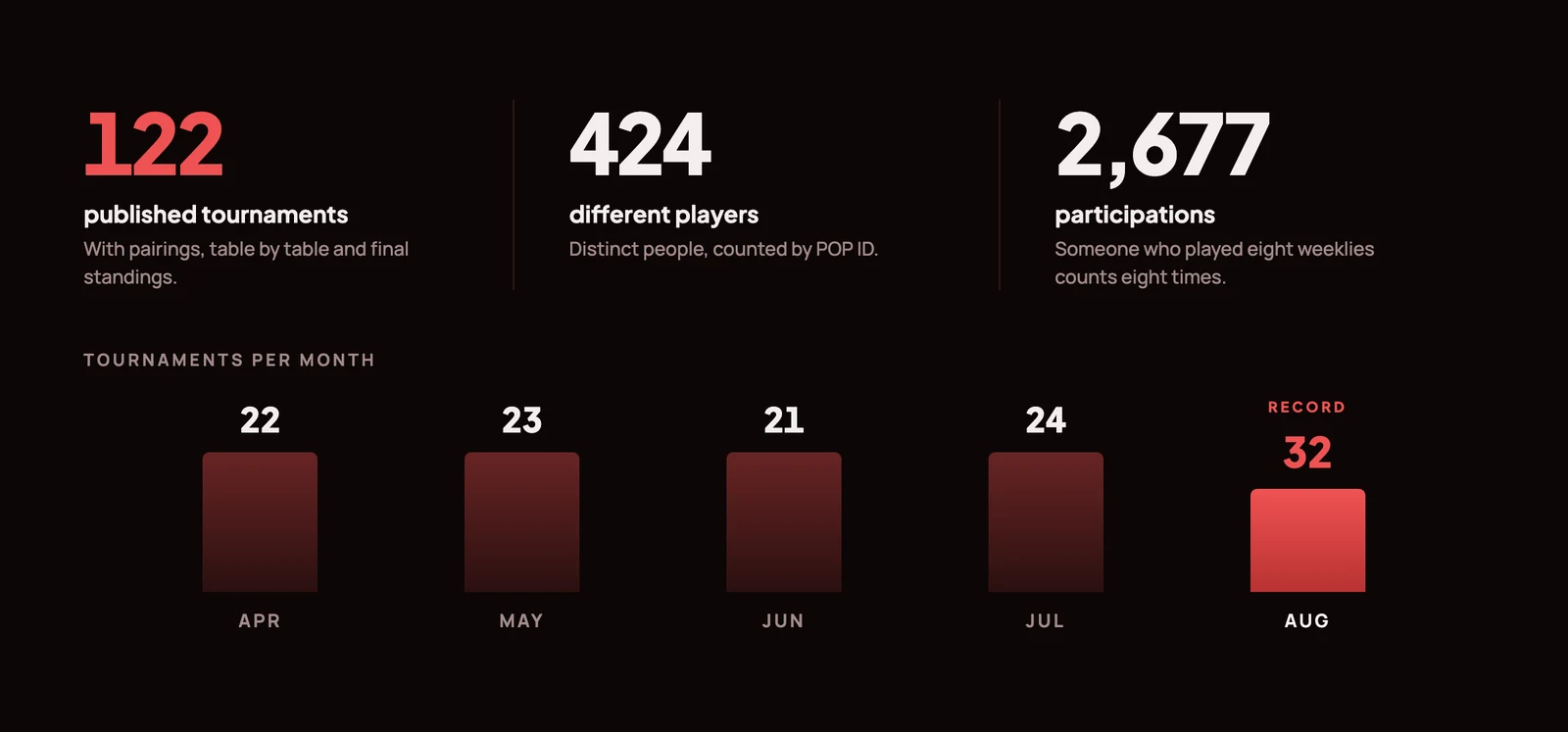
Look at the jump in August, and look at the difference between a player and a participation, which is the count people get wrong the most.
The ranking closed with Dyego Rathje in first at 1284 Elo, Álvaro Miguelino second at 1281, and Hudson Matheus third at 1226.
Three points between first and second. And you can see how each of them got there, which is the part I could not have told you in April. Dyego played 46 matches and lost five. Álvaro played 189, four times as many, and held almost the same Elo doing it. Two completely different seasons ending in the same place.
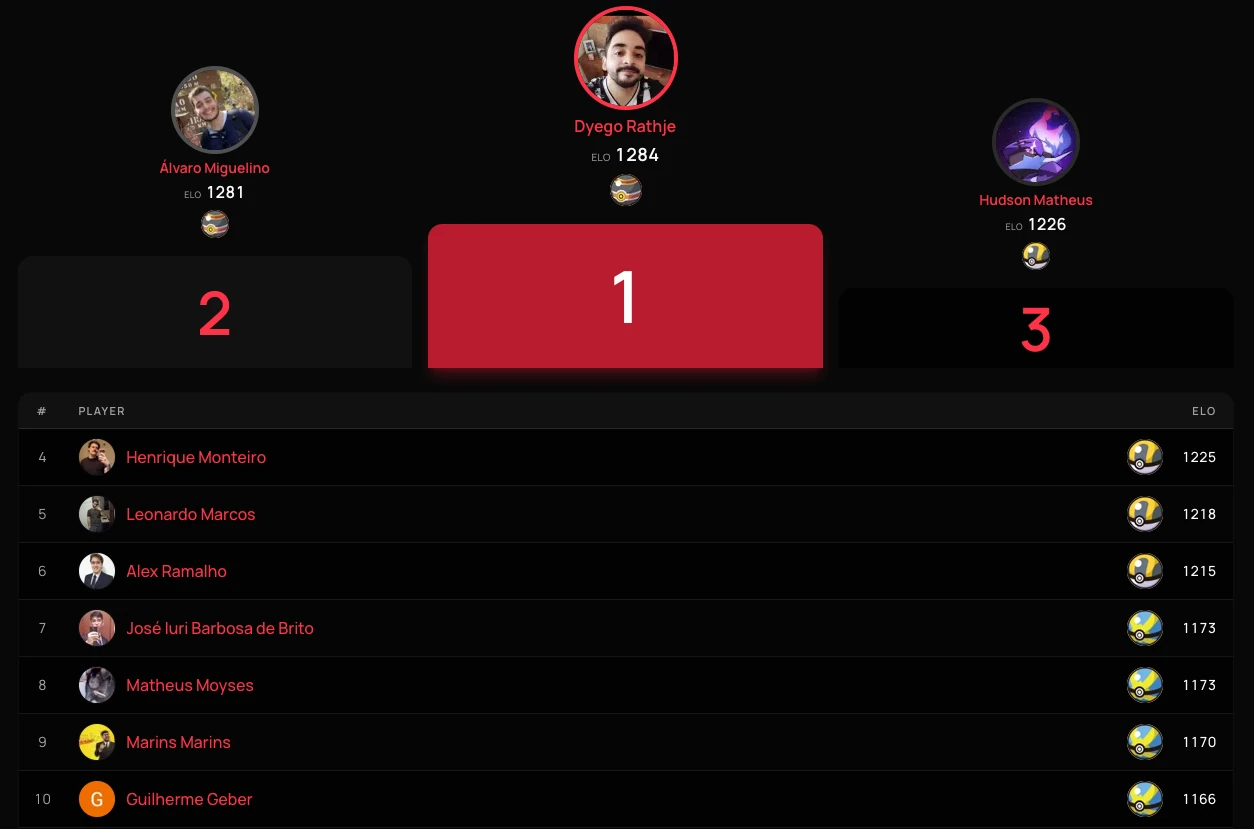
Dyego got to those 46 games because he became Maria's father this season. He is the scene's newest Pokédad, and anyone who has had a newborn at home knows what happens to your tournament calendar. He showed up less, lost almost nothing, and now he is taking a break. A break, not a retirement.
Eleven years ago he had 108 points and first place in a ranking I maintained in a spreadsheet. Now he has 1284 Elo and first place in a ranking that calculates itself, and you can open the whole thing right here.
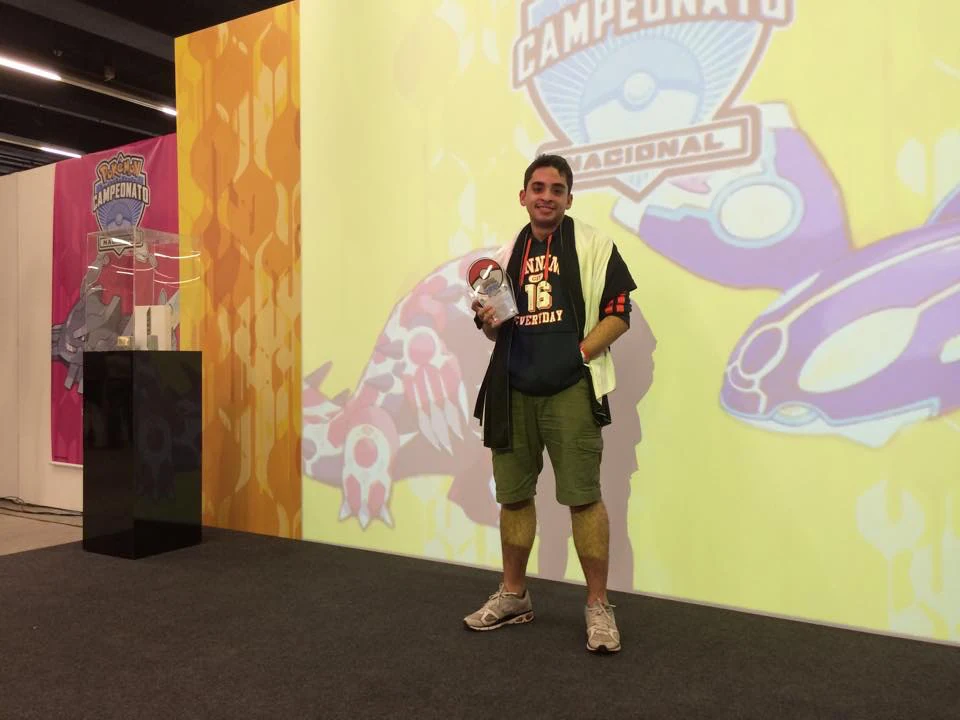
And there is something from 2015 that was not in our spreadsheet: the same year he won that BH Ranking, Dyego was the national champion.
There is nothing fairer than the first champion of this site being him. Again.
And it is not just him. I went through that 2015 top 8 name by name, and most of that crew is still here.
Dyego, champion in both. Alex Oliveira, who was third and writes on the site today. Gustavo Daniel, the Feral, who showed up to more tournaments than anyone else in that crew this season and still signs with the same nickname from eleven years ago. Renato Christian, who moved to Brasília and therefore barely shows up in our ranking, but keeps playing over there. And me.
The site vanished for eight years and this crew never left. That is the most beautiful thing I found while writing this article, and it was not in any number: it was in the list of names.
The metagame also became something you can actually look at, and that is 100% down to you: 1,698 of the 2,677 participations have a deck tagged, or 63%. Each one is somebody who came in here and said what they played.
There is a layer above that, which is the full decklist, all 60 cards. Players sent in 165 decklists. A decklist is the most tedious piece of data there is to collect, because there is no way to automate it, somebody has to sit down and type. Álvaro alone sent 38, almost a quarter of the total, and José Iuri sent 14. I sent 9, and I own the site. If any deck number here looks trustworthy to you, there is manual work from people in the community behind it.
You can also see who holds the scene up. The stores with the most traffic were Vespa TCG with 2,113 visits, Dimensão Alternativa with 2,038 and Stop TCG with 1,877, followed by Vault of Cards with 1,290, For Fun Arena with 680 and UG Card Shop with 299. That last one is funny: the 2015 ranking had an entire column just to count UG Card Shop championship points. Eleven years later it is still in the store ranking. The gap between first and third is 11%. I opened that list expecting to find one store dominating and the others fighting over scraps, and that is not what is happening. Three of them are pulling together.
Now the size of the audience. In five months there were 20,096 page views and 2,077 unique visitors, measured in our own database, without my own visits, without localhost and without bots.
This chart separates those two things, because they get confused a lot, and shows where those page views happened:
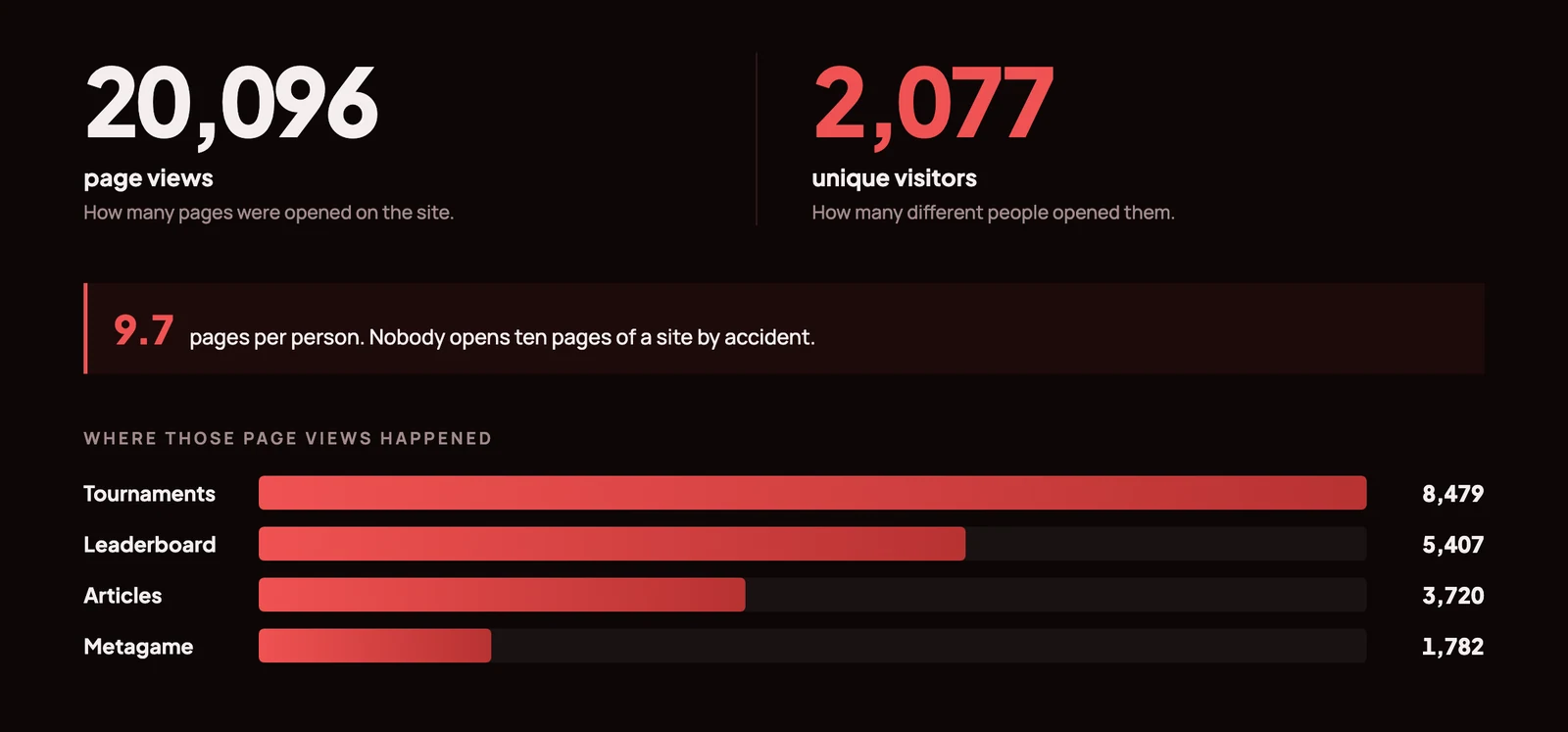
I started this as a blog, by the way. And text is the third most viewed thing here. What brings people in is tournament results and ranking position. Content did not stop, there are 50 published articles, half in Portuguese and half in English, with six different authors writing, but the data is clear about what opens the door.
Now I need to explain something before I give you the next number, otherwise it looks like it contradicts the one above.
The 20,096 page views and the Google search clicks do not measure the same thing. Most people who come in here already have the link: they came from the WhatsApp group, from Instagram, or they typed the address because they already knew the site exists. Google search is only one of the doors, and it is much smaller than the direct one.
But it is the only door that brings people who do not know me. And that is where it gets interesting.
TCMG has already appeared in a Google search result in 103 countries. A hundred and three.
And again I am going to separate two things, because there is a difference between appearing and entering. In those 103 the site showed up on somebody's screen. In 32 of them the person clicked and came in:
Brazil, 263 clicks
United States, 64
United Kingdom, 15
Italy, 9
Germany, 5
And from there it goes down a line that passes through Australia, Mexico and Chile and ends in Mongolia, which had exactly one impression and one click. A hundred percent click-through rate, and I have no idea who that person is.
Of the 400 search clicks in the period, 137 came from outside Brazil. A third.
Inside the site the numbers agree with that: 998 sessions opened the English version, against 1,285 in Portuguese. Almost half.
I did not have to guess why, because the search terms give it away: nearly twenty of those clicks are people looking for "bronzong lopunny" and variations of the name. An article in English, about a deck nobody saw coming before Worlds, is what is bringing the world in here.
Inside Brazil, GA4 shows Belo Horizonte in front with 579 users, then São Paulo with 185, Contagem with 61, Porto Alegre with 48, Rio with 42 and Betim with 40. Adding up the cities in Minas Gerais I can identify on that list gives 818 out of 1,712 users. Which means more than half of the people reading TCMG are not from Minas Gerais.
Average engagement time per user came in at 4 minutes and 58 seconds. Nobody spends five minutes on a site by accident.
Eleven years, and the same first line
Something caught me off guard while I was writing this article.
While the old site was online, I was also writing outside of it. In November 2015 I had a byline at Copag. If you search for "Wallysson Lima do Couto" you can still find my pieces there. And one of them, about a Lucario/Crobat that won Rio in Henrique's hands and Curitiba in Pedro's, opens like this:
"E aí, galera, como estão indo nos regionais?"
Eleven years later, the article you are reading opened with "Hey everyone, Wallysson here." It is the same first line, and I did not do it on purpose.
One thing did change between that piece and this one. In 2015 everything was on paper. Decklist on paper, results on paper, and whatever you remembered from the tournament, nothing else. Today I write an article and I can link the tournament, the ranking, the player and the list he played, all clickable. After ten years writing about this with a pen in my hand, seeing it work like this is incredible.
What I try to do with content is the same thing I was trying to do back then: a stronger community, a more united one.
What is not standing yet
I am not going to sell you a perfect site, so hold on to two truths.
The first one is the bill. The quadripack for the monthly ranking winner comes out of my pocket. So does the booster raffled among people who tag their decks. Vespa TCG covered one month's prize, and thank you genuinely for that. For the rest, I paid. And that is not a problem for me, I paid because I wanted to and I would do it again, because a prize every month is what makes the ranking feel like a competition instead of a pretty table. But I am not going to pretend that bill scales. A better prize, a prize for more people, an in-person event: none of that comes out of my pocket.
The second one is the metagame. We are at 63% of participations with a deck tagged. That is much better than I expected in the first year, and it is still not enough, because the missing 37% do not go missing at random: they tend to be exactly the decks nobody wrote down, which pushes the percentage on screen in the wrong direction. My goal for Kanto is to reach at least 70%. From there up it stops being an indication and starts being a statistic.
Both of those depend on people, not on code.
Where this is going
I am going after partners, and I am going to do it the right way: showing real numbers, the way they are in this article, and not inflated ones. A site that documented 122 tournaments and 424 players in five months has value for anyone selling cards in Minas Gerais. If you are a store, a distributor, a brand, or you know someone who is, get in touch. A bigger prize and a better event go through that.
On your side, three things that take two minutes each and change the whole site:
1. Create your account and link your POP ID. That is what unlocks everything else: your history, your profile and deck tagging.
2. Tag the deck you played. Whoever tags is entered in the booster raffle every month, so there is a prize in it. And it is what takes us from 63% to 70%.
3. Send the decklist, if you are up for it. It is not mandatory and it is more work, but it is what turns "Dragapult showed up 40% of the time" into "here is the list that won and the tech nobody had seen".
The real reason for all three is what comes next. With decks tagged consistently I can show you your matchups: what you beat, what beats you, and where you are leaving points on the table. The idea is for the site to stop being a place where you check results and become a tool where you watch yourself improve as a player. There is no way I build that alone, because the data is you.
TCMG Champions
Now the thing I most want to do.
When the ranking that started today closes, I want to run the TCMG Champions: the top 16 of the ranking in a double elimination bracket, playing to decide who is the best.
There is no date and no venue. Kanto Edition runs until August 31, 2027, so it is for after that, and I am going to chase a partnership to make it happen. But I want it on the record today, on the first day of the season, because now there is one more reason to want to be at the top here. It is not just the table: it is a seat in those 16.
Kanto started from zero. Whoever closed Pokeball at 1284 and whoever closed at 1000 sit at the same starting line, because Elo resets for everyone. If you have never shown up in a ranking, this is the season to start.
Thank you to everyone who played, who sent files, who opened the store on Saturday, who sat down to type a decklist and who searched for TCMG on Google.
And a separate thank you to the people who wrote here with me over these five months: José Iuri, Guilherme Geber, Álvaro Miguelino, Tiago Marins and Alex Oliveira. You signed 18 of the 50 published articles. I started this alone inside a work challenge and today there are five more people writing, which is the part I least expected to happen this fast.
Thirteen years ago Leozinho and I were trying to build the metagame of the whole country in a spreadsheet, by hand, just the two of us. Yesterday this site closed a season with 122 tournaments and 424 players in it, and it did the whole calculation while I was asleep.
I lost a TCMG once. This one I am not going to lose, and the difference is that I am not the only one holding it up anymore.