
Hey everyone!
Delta Reign (Storm Emeralda in Japan) comes out on November 6, with Mega Rayquaza ex as the headline card of the set. But while we wait for the release, players in Japan have been using these cards since the end of July, which gives us a much better idea of their impact on competitive play.
Dragapult is still one of the strongest decks in the format, and the new cards seem to have mostly helped Mega Kangaskhan ex builds. Talonflame has already found room in different lists, the new Legendary Stadium brought an interesting disruption option, and a few cards that didn't get much attention at first started showing up in tournaments.
For this Delta Reign top 5, I took into account the Japanese results, the potential of each card and how much I think it can influence our format.
The Talonflame ex and Special Vest images are the Japanese versions, because the English versions of these cards only come out at release. As soon as they're out, I'll swap the images here.
Let's get to the ranking!
Talonflame ex
Legendary Pyroduct
Aarune
Mega Rayquaza ex
Special Vest
5. Special Vest
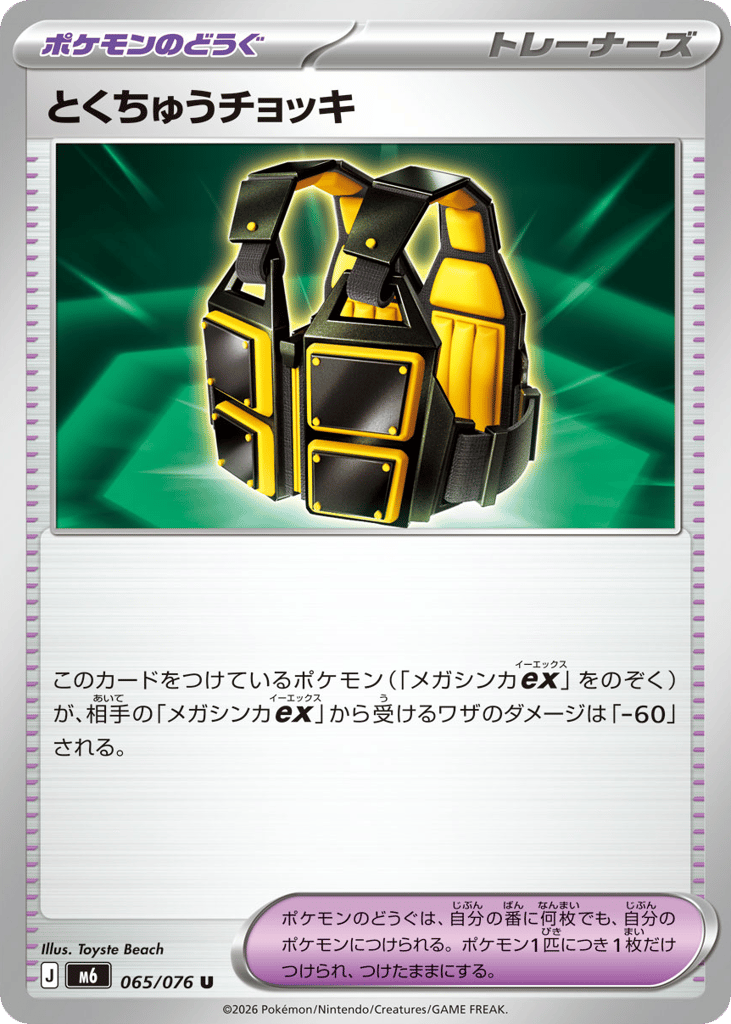
Special Vest is a card that could become a lot more important depending on how the metagame evolves, especially after the next rotation.
The Tool reduces damage from attacks of Mega Pokémon ex by 60, as long as it's attached to a Pokémon that isn't a Mega.
It may look like a small reduction, but in the Pokémon TCG we know how 10 or 20 damage can completely change a game. Now imagine 60.
Mega Excadrill ex is a good example. With five Energy, it deals 330 damage, enough to Knock Out a Dragapult ex with its 320 HP. With Special Vest attached, Dragapult only takes 270 and survives with 50 HP, as long as it had no damage before.
That means your opponent may need one more attack to get the Knock Out.
And this is where one of the most important things in competitive play comes in: the prize race.
A lot of games are decided by how many attacks each player needs to take their six Prize cards. If your opponent planned to win with two Knock Outs and you stop one of them, you may gain the turn you need to turn the game around.
Of course, surviving doesn't automatically mean you're ahead. You still have to consider the damage already on the board, the resources available and your ability to keep attacking.
Against Mega Rayquaza ex, for example, Special Vest also changes important numbers. Rayquaza needs seven Fire and Lightning Energy in play to Knock Out a 320 HP Dragapult. With the Tool, it needs eight.
But the card has a very clear limitation: it does nothing against attacks from Pokémon that aren't Megas.
In the Dragapult mirror, it doesn't help. Against attackers like Talonflame, Raging Bolt and Ogerpon, it doesn't protect you either.
That's why, right now, I don't consider Special Vest a mandatory inclusion. It shows up in some Japanese Dragapult, Grimmsnarl and Zoroark lists, usually as a single copy, precisely for specific matchups.
What puts this card in my top 5 is thinking a bit further ahead.
With the next rotation, we may get a format even more focused on Mega Pokémon ex. If that happens, a Tool that can break important damage numbers could become much more relevant.
There's no way to say for sure that this will be the case, but it's a possibility worth watching.
For now, Special Vest is fifth. It's a situational card today, but one with room to grow a lot depending on the next few months.
4. Mega Rayquaza ex
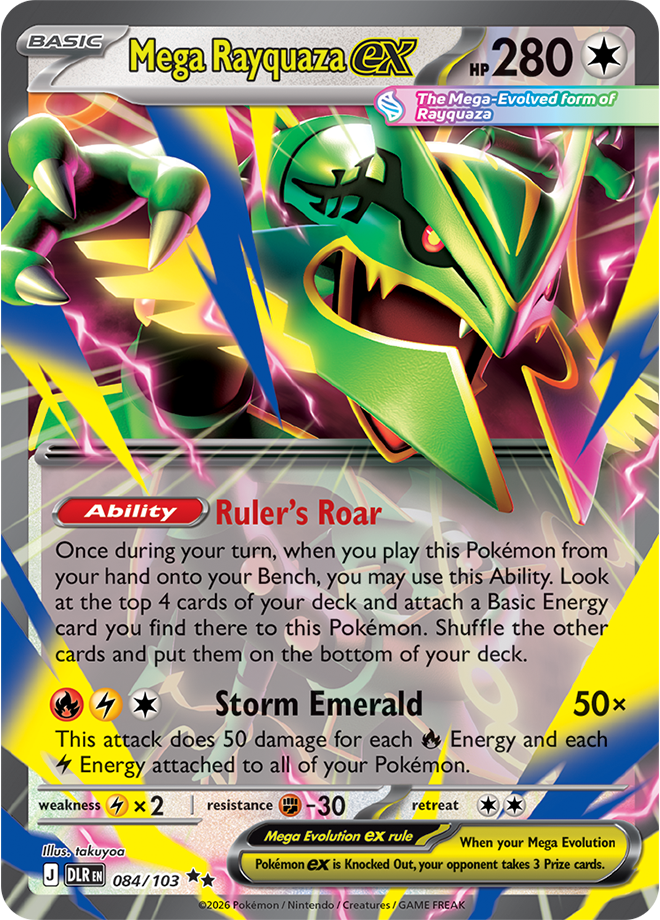
Mega Rayquaza was one of the most promising cards when Delta Reign was announced.
Its attack does 50 damage for each Fire and Lightning Energy attached to your Pokémon, which lets it reach very high numbers without having to put all the Energy on Rayquaza itself.
On top of that, its Ability lets you look at the top four cards of your deck when it's played onto the Bench and attach a Basic Energy you find there to it.
At first the deck got a lot of attention in Japan, but it lost ground as the format evolved.
That doesn't mean it's bad. Rayquaza took 13th and 17th at Champions League Yokohama, which shows it can compete.
What bothers me is how many resources it needs to get the most important Knock Outs.
Against Dragapult ex, for example, you need seven Fire and Lightning Energy in play to reach 350 damage and take the Knock Out in a single attack.
It's possible, especially with help from Ethan's Ho-Oh ex and cards like Energy Switch. But you can't always keep that much Energy in play, especially against decks that take Knock Outs very fast and clear your Energy.
Dragapult itself spreads damage while setting up its next attackers, making life hard for the Pokémon carrying the Energy.
I also don't love Rayquaza's 280 HP for a Pokémon that gives up three Prize cards. If your opponent takes down two Megas, the game is over, so you have to make every attack count.
The Japanese lists try to get around this with Mega Kangaskhan ex, Talonflame ex and Latias ex, which give the deck other attacking options and better mobility.
A Rayquaza list took second at a City League in Aichi with four Kangaskhan, two Rayquaza, two Talonflame and two Ho-Oh ex, plus 15 Basic Energy.
It's an interesting build, but it also shows how much space the deck has to dedicate to making Rayquaza work.
I think it can keep putting up good results. I'm just not convinced it will be one of the main decks in the format.
For now, it's fourth.
3. Aarune
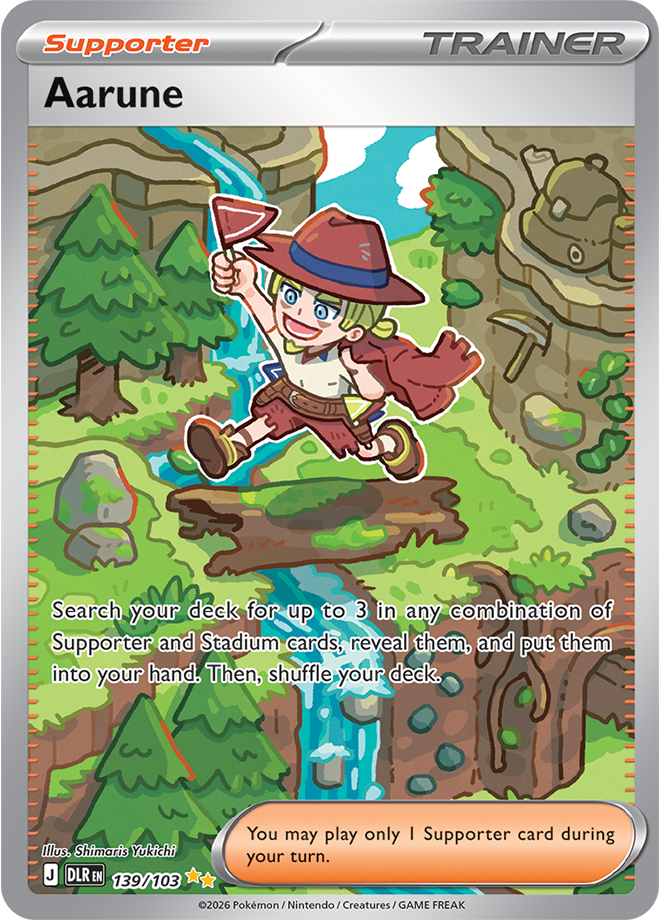
Aarune is one of the cards I liked the most in Delta Reign, mainly because it can search for Stadiums.
Its effect lets you search your deck for up to three cards, in any combination of Supporters and Stadiums, and put them into your hand.
That's a really interesting search, especially in a format where Stadiums can decide games.
One example is Legendary Pyroduct itself, which we'll see in second place. Since you need to find both halves to put it into play, Aarune can grab both with a single card. And you still have one search left to secure a Supporter for next turn.
But I wouldn't limit Aarune to that interaction.
Think about how often you need a specific Stadium to answer your opponent.
Against decks that rely on Abilities, for example, finding a Team Rocket's Watchtower at the right moment can change a game. The same goes for removing an opposing Stadium that's hurting your strategy.
Aarune gives you that option without depending on drawing into the card you need.
I also like the flexibility to set up future turns. You can search for a draw Supporter, a Boss's Orders or any other card that's part of your game plan.
But there's an important difference between finding those cards and actually using them.
Since Aarune already uses your Supporter for the turn, you'll usually have to wait to use the Supporters you searched. And if your opponent uses any kind of hand disruption, you can end up losing the resources you just found.
Also, when you need Pokémon, Energy or Items right away, Aarune may not solve your problem.
Even with these limitations, I see a lot of potential.
In Japan, it has already shown up in Mega Lucario lists and other strategies. That doesn't mean it's mandatory in those decks, but it shows the card can have room outside of Legendary Pyroduct builds.
And I think that's exactly its biggest strength.
Aarune doesn't depend on a specific Pokémon to work. Its value comes from the Supporters and Stadiums available to us, which can stay relevant as new sets come out.
I don't think we'll see four copies in every deck, but I can picture different strategies running one or two.
That's why it's third in my ranking.
2. Legendary Pyroduct
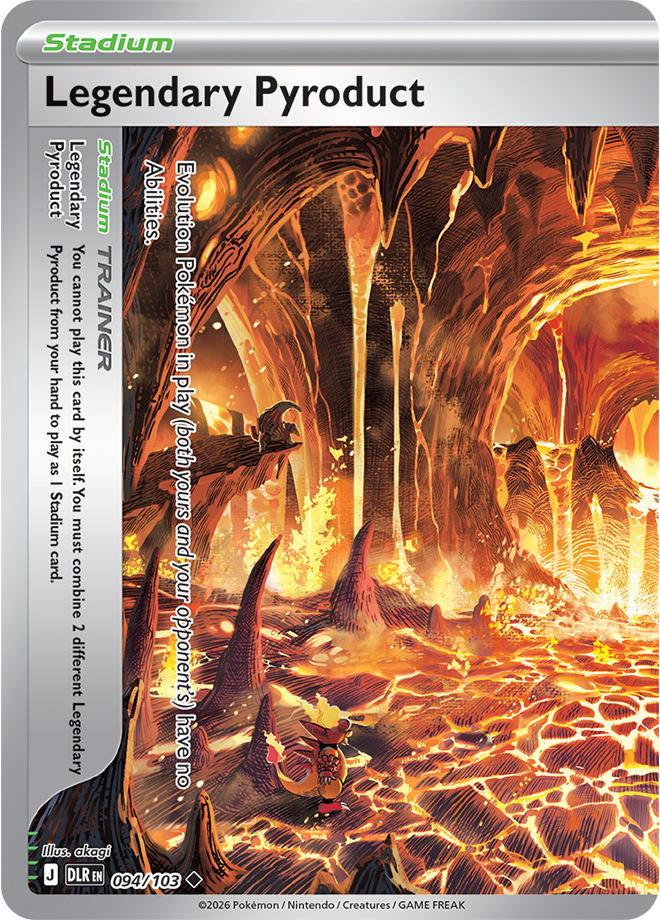
Legendary Pyroduct is one of the cards that can most influence the way players build their lists.
It's a Stadium split into two halves, which have to be in your hand together to be put into play. While it's in play, both players' Evolution Pokémon have no Abilities.
And that's a very relevant effect against Dragapult.
A big part of the deck's consistency comes from Drakloak's Ability, which finds the cards it needs to keep developing the game. Depending on the version, there's also Dudunsparce and Dusknoir, which are other important pieces.
With Legendary Pyroduct in play, all of those Abilities stop working.
But I don't think it's a card that can fully lock Dragapult.
The deck can still use Abilities from Basic Pokémon like Fezandipiti ex and Meowth ex, and any Stadium the opponent plays removes Legendary Pyroduct.
What really interests me is the combination with cards that disrupt the opponent's hand.
Some Japanese lists already run Judge, Unfair Stamp and Special Red Card alongside the new Stadium.
That means you can shrink your opponent's hand while stopping them from using Drakloak to find the resources they lost.
Against Dragapult, delaying them by one turn can make a big difference, especially when you use that time to set up an important Knock Out.
The problem is executing this strategy consistently.
To run two full copies of the Stadium, you need to set aside four spots in your list. You also need to find both halves and, ideally, have some way to disrupt your opponent's hand on the same turn.
That's a big investment for a card that any other Stadium can remove.
I also see it being played alongside Noctowl, which can search for two Trainer cards when you have a Tera Pokémon in play, meaning both halves of the Stadium at once. That could be really fun in some kind of slop box.
And it's not just Dragapult that suffers. Zoroark also has problems if it gets hit by Legendary Pyroduct, because its draw Ability stops working.
If your Evolution deck is struggling against it, just raise the number of Stadiums in your list.
I don't think it's enough to knock Dragapult off the top. But I consider it a strong card, especially in decks that use Basic Pokémon and can take advantage of the disruption without hurting their own Abilities.
That's why it's second.
1. Talonflame ex
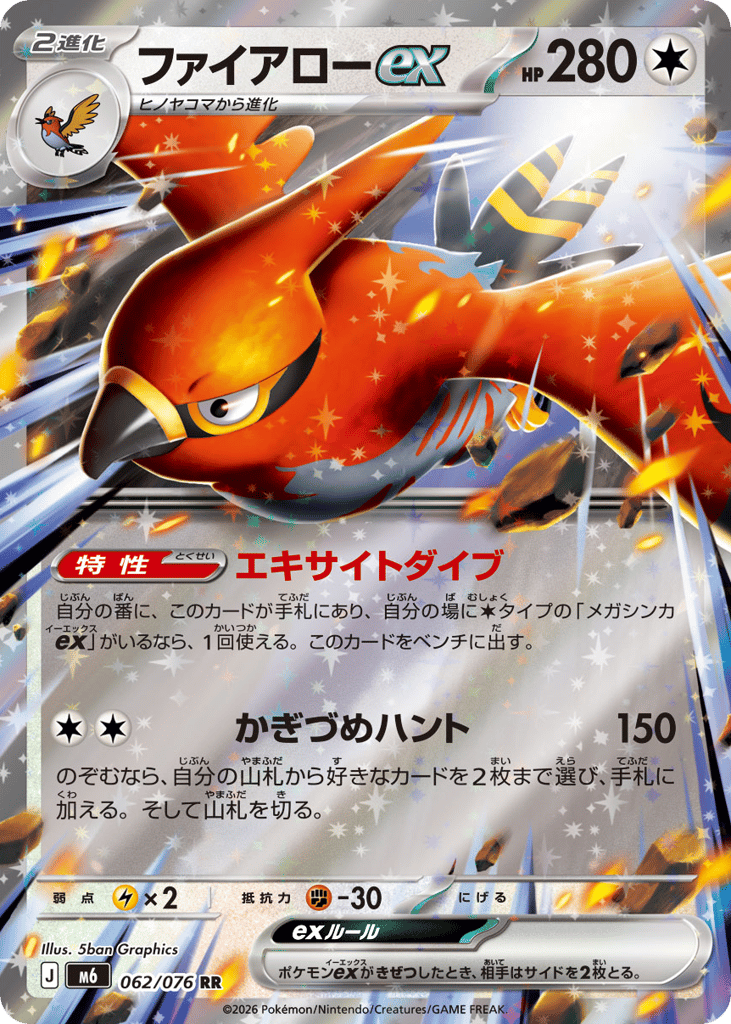
For me, Talonflame ex is the best card in Delta Reign.
Its Ability lets you put it from your hand straight onto your Bench, without evolving, as long as you have a Colorless Mega Pokémon ex in play.
And Mega Kangaskhan ex turned out to be the ideal partner.
Talonflame has 280 HP, free Retreat and an attack that does 150 damage while searching your deck for any two cards.
The attack alone is already interesting. But I think the card's main strength is how it fits into Kangaskhan builds.
Those decks run several Megas that give up three Prize cards when Knocked Out. Having a two-Prize attacker can be very important, especially in games where you don't want to give your opponent the chance to win with only two Knock Outs.
Talonflame can attack, pressure smaller Pokémon and find resources to set up the next turns.
And all of that without needing Fletchling or Fletchinder.
One thing I really liked in the Japanese lists is that you don't always need a specific package to make this card work.
In the Rayquaza or Ogerpon versions, for example, Talonflame can use the Basic Energy and Energy Switch that are already part of the strategy.
Kangaskhan is already in the list, so you don't have to spend many extra spots just to enable Talonflame.
In Evolution decks, things are different.
There's an interesting combination with Hilda and Ignition Energy that lets you find Talonflame, put it into play and pay for its attack quickly.
This play also works against Budew, since it doesn't rely on Items.
But I don't think that means you should put Talonflame in every deck.
In decks that already run Kangaskhan, though, Talonflame looks much more interesting.
I also like its 280 HP. Dragapult's Phantom Dive does 200 damage to the Active Pokémon, so without prior damage or some other way to boost it, it can't Knock Out Talonflame on its own.
And the free Retreat makes it much easier to move your attackers around during the game.
Of course, it has limitations.
150 damage isn't enough to Knock Out many of the format's main Pokémon ex, and the two cards you search with the attack can still be lost to a Judge or another kind of disruption.
On top of that, you can end up giving up two Prize cards to take just one, depending on how you use it.
But I think the upsides are worth it, especially in builds that already run Mega Kangaskhan.
Talonflame gives you more attacking options, improves access to your deck and is already proving its value in the Japanese results.
I don't think it's mandatory in every deck, but out of everything new in Delta Reign, it's the card that convinced me the most so far.
That's why it's first.
Final thoughts
Delta Reign brought some interesting cards, but I don't think we'll see a complete shift in the metagame because of this set alone.
Dragapult is still one of the main forces in the format, while Mega Kangaskhan builds got new tools to fight for a spot.
Talonflame is the card that catches my attention the most, both for what it has already shown in Japan and for its versatility. Legendary Pyroduct also deserves respect, especially if Evolution decks keep dominating tournaments.
Aarune can find its place thanks to how easily it finds Stadiums and sets up future turns, while Special Vest is a card I'd keep an eye on for the future of the format, especially if Megas gain even more ground after rotation.
Among the cards that didn't make the list, I want to keep watching Azurill and Cacturne, which have interesting effects but still need more results to earn a spot in the ranking.
It's also worth remembering that Japanese results are a reference, not a guarantee that we'll have exactly the same format outside Japan.
For now, these are the five cards I find most interesting in Delta Reign.
What about you, do you agree with the ranking? Is there a card I left out that deserves more attention? Leave a comment below so we can discuss it.
See you next time!