There's a phrase every competitive player has heard, usually right after losing: "the right play was something else." And, technically, that statement is almost always correct. There's almost always a line of play that maximizes your chance of winning given what you know at that moment, what's public, what you can calculate. The problem is that this phrase hides an assumption nobody stops to question: that the goal of playing is only to win that game, against that opponent, isolated from everything else. And that assumption is, most of the time, false.
Inspired by the wonderful article from my friend and teammate Álvaro Miguelino (Every Decision Matters: Why You Should Complain Less and Optimize More) I decided to write this one. In one section Álvaro discusses the "non" existence of a play style, or how players lean on that concept to justify wrong plays. In this article I try to do the opposite: not only to argue for the existence of a play style and how it influences certain choices, but also to justify situations in which suboptimal plays can be the plays that would change the fate of a game.
Anyway, this text is about the difference between two questions that seem like the same thing but aren't: "what is the optimal play?" and "what is the play I should make?"
Local optimum, global optimum
Every competitive game with incomplete information has, at some level, a mathematical answer. Given the current state (my cards, my Pokémon, my hand, the probabilities of what's left in the deck), there's a line, or a set of lines, that maximizes the expected value of that specific decision. That's the "optimal play" in the strict sense: a real, calculable object, one there's almost no debate about once the numbers are on the table.
What pure theory tends to hide is that this optimization happens inside a box: the isolated decision, within a single hand, a single turn, a single game. But almost no competitive game is played inside that box. It's played inside larger systems: a best-of-three match, a group stage, a whole season, a career. And what's optimal for the small system can be terrible for the big one. This mismatch between the local optimum and the global optimum is the thread running through everything that follows.
It shows up in different ways in different games, but the pattern is always the same. Let's take it step by step.
Poker: when expected value isn't the right metric
Poker is, historically, the most explored testing ground for this discussion, because it forces the player to deal with real money and real variance at the same time.
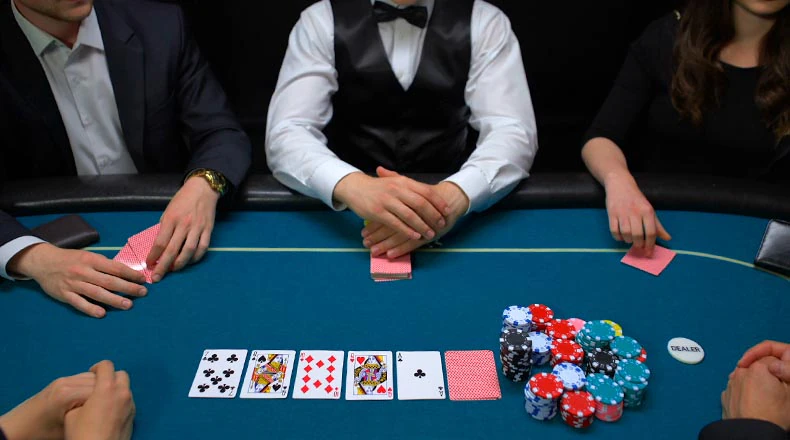
Managing what you have to risk. A player with little available money tends to avoid a bet that's clearly favorable on paper, because if it goes wrong, the loss can knock them out of the game before luck even has a chance to even out over the long run. That's not "playing badly": it's understanding that the expected result of a single play doesn't capture the risk of simply running out of money to keep playing. There's even a well-established mathematical formula just for calculating how much to risk on each bet and grow as fast as possible without running that risk, which already shows that "how much to bet" is a problem just as important as "which play to make."
The value of each chip changes over the course of the tournament. In tournaments with tiered payouts (first place wins far more than tenth, but everyone who cashes wins something), the value of each chip isn't constant. Winning chips when you're already comfortably in the money is objectively worth less than avoiding losing them, because the jump from "eliminated with nothing" to "winning something" is enormous, while the jump from "middle payout" to "first place" is proportionally much smaller. This means a play that's mathematically favorable in chips can be unfavorable in what actually matters, the money you take home, and top-level tournament players give up these "correct" plays all the time to protect their own position in the payouts.
Chess: when the machine disagrees with the person sitting at the board
Chess gives the cleanest example of this divergence between the "machine optimum" and the "practical optimum", because today any move can be evaluated objectively by an engine.
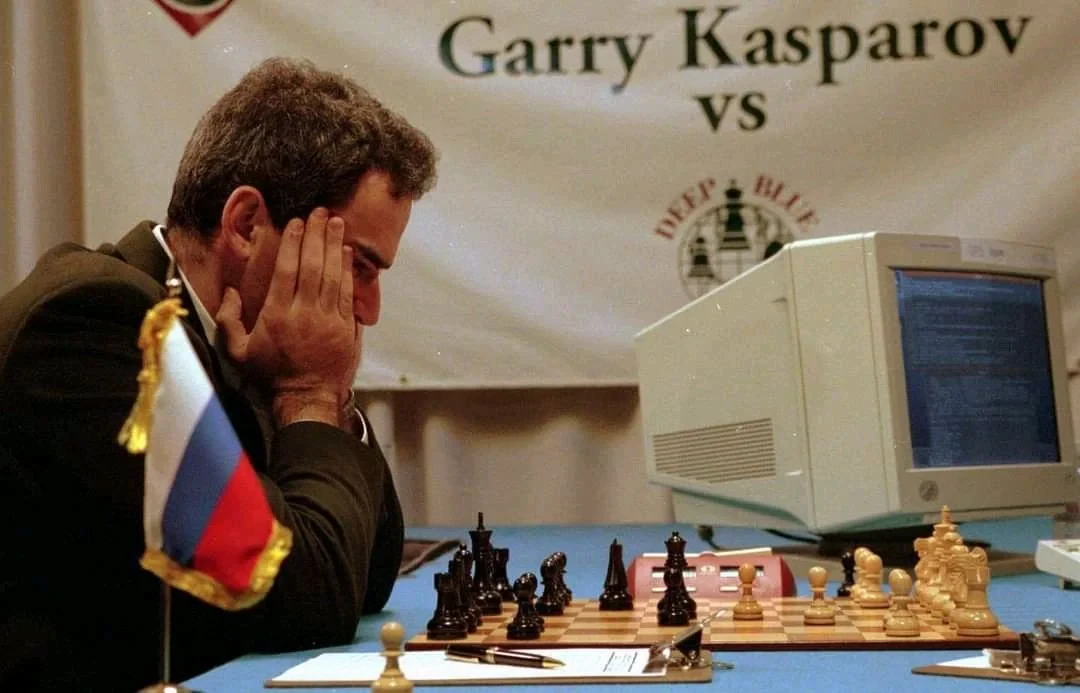
High-level players fairly often choose lines the computer rates as slightly worse, say -0.3 instead of 0.0, because those lines lead to tactically more complicated positions, and the opponent, under time pressure or outside their theoretical comfort zone, is more likely to slip there. This is called "practical chances": the difference between the objective evaluation of a position and the real probability of converting it against a human opponent, with a clock, fatigue, and a specific opening repertoire they know well or poorly.
Clock management is another entire axis of decision that position evaluation simply doesn't see. An "almost optimal" move made in three seconds can be worth more than the "perfect" move that eats ten minutes off your own clock, because the time left at the end of the game is itself a resource of the game, and spending it poorly in a non-critical position can cost you the game in a critical position later on.
There's also the variable of your own rating and the tournament format: a player who only needs a draw to secure a norm or qualification deliberately plays closed, simplified positions, avoiding complications that would objectively give more winning chances, because the real goal there isn't "the highest chance of winning this game", it's "the highest chance of hitting the tournament target."
Magic: The Gathering and the logic of "play to your outs"
Magic has an almost folkloric expression to describe exactly this phenomenon: "play to your outs" versus "play the odds", playing for the scenario where you can still win, versus playing the line with the highest average probability.
If you're behind across the average of all the opponent's possible hands, playing "the statistically correct line" often means losing anyway against most scenarios. In that case, the rational play can be to abandon the line with the highest average return and deliberately choose the line that only wins against a specific subset of the opponent's hands (even if that line is worse against the average), because against the average you were already losing anyway.
Other systems, the same pattern
The phenomenon also shows up strongly in team-based e-sports, like League of Legends, Valorant or Counter-Strike, in something known as the "comfort pick".
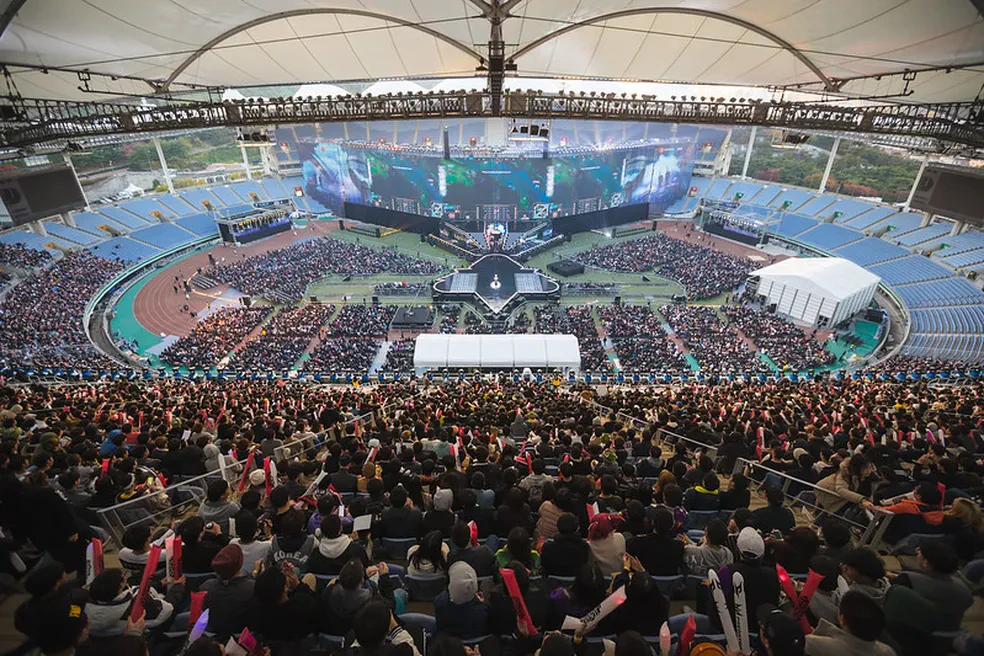
Every match of these games starts with a phase of picking characters or strategies, done with partial information about what the opposing team will choose. At each moment of the game (the "meta"), there's a relatively objective hierarchy of which characters or compositions are statistically stronger, measured across millions of matches in public databases. And even so, professional teams routinely pick an option a few rungs below the top of that hierarchy. A specific player on the team has hundreds or thousands more hours of practice on that choice than they would on the "strongest" option, and that execution gap offsets, and sometimes even outweighs, the theoretical power gap between the two options.
This calculation gets even more complex in a team game, because one player's choice directly affects the option space of the other four. A "technically superior" character may require a team synergy the team hasn't had time to train, while a simpler, more familiar composition lets the team fluidly execute something it has rehearsed dozens of times. There's also the factor of frequent game version changes (patches): every time the balance shifts, the theoretical power hierarchy is recalculated almost overnight, but the players' accumulated experience doesn't disappear overnight along with it, which means that, for a while, the "old and slightly nerfed" option can still, in practice, beat the "new and theoretically stronger" one, simply because nobody on the team knows how to play it well yet.
Professional teams and coaches also take into account the specific opponent of the match, deliberately avoiding choices that are strong in general but that the rival team has already faced and knows how to neutralize, in favor of less-explored choices that create a new problem for the opponent to solve live, under pressure, with no time to prepare. Here, again, the "best pick in theory" loses to the "best pick for this match, against this opponent, with this team."
In all these cases, the underlying pattern is the same: there's a structural difference between optimizing an isolated decision and optimizing within a larger system. The system can be a match, a multi-day tournament, a whole season, or a team's learning curve. And the calculation that ignores that larger system, however correct it may be inside the little box where it was made, is solving the wrong problem.
Personal style as a variable of the game, not as noise
Here comes a second axis, somewhat orthogonal to the previous one, that also separates "optimal" from "what should be done": the personal style of whoever is playing.
The way each person plays isn't an imperfection to be corrected on the way to "perfect play". It's a real variable that affects which play is, in fact, the best for that specific person. A very aggressive player, who feels comfortable taking risks and plays better under the pressure they impose themselves, often turns a line that's "slightly suboptimal on paper" into a practical advantage, because they execute it with more confidence, more speed and less hesitation than they would a theoretically superior line outside their comfort zone. A more conservative player does the opposite: they systematically prefer the lower-variance line, even with a slightly lower theoretical win rate, because it reduces execution errors under stress, given the number of repetitions.
This isn't an excuse to play badly. It's recognizing something pure game theory tends to ignore: the optimal play assumes a perfect executor, and perfect executors don't exist. The real value of a play depends not only on how good it is on paper, but on the real chance of you executing it correctly under the conditions of that moment: fatigue, anxiety, time remaining, history against that specific opponent. A "worse" line that you execute almost always with precision can, in practice, beat a "better" line that you only nail once in a while, because it demands a read or a sequence that isn't natural to your way of playing.
This also explains why two players of similar level, looking at exactly the same position, can legitimately disagree about what "the right play" is without either of them being wrong, because the correct answer, in practice, depends in part on who's going to execute it.
The psychological factors behind the decision
If the objective function of the larger system and personal style already complicate the idea of the "optimal play", the psychological factors complete the picture. It's worth breaking down a few carefully.
Loss aversion. Losing resources hurts psychologically more than gaining the same amount feels good (discarding two cards, for example, can weigh more on your mind than drawing two cards). This leads players to avoid lines that involve clear, visible sacrifice, even when that sacrifice is mathematically correct, and leads others, at the opposite extreme, to bet everything on a desperate comeback play just so they don't have to admit, even to themselves, that they're already losing.
The sunk cost fallacy. Players keep investing resources in a line of play because they've already invested in it before, even when new information shows they should abandon it. Clinging to a setup, a plan, an already-prepared Pokémon, even when it has stopped making sense, is the sunk cost fallacy disguised as strategic consistency.
Tilt. After a run of bad decisions or bad luck, your emotional state changes your very ability to calculate correctly. The play that would be optimal calculated in cold blood stops being accessible, because the person is no longer calculating, they're reacting. Tilt doesn't change the math of the game; it changes the hardware processing that math.
Confirmation bias and reading the opponent. Players tend to interpret their opponent's plays in a way that confirms the read they'd already made, adjusting their own line of play based on a biased read rather than a neutral read of the current situation.
Overconfidence. Experienced players tend to overestimate the accuracy of their own calculation, especially in positions they recognize from memory. That's what leads them to skip verification steps they'd take in a new position, and to slip up precisely on the lines where they feel most secure.
Anticipated regret minimization. Some decisions are made not to maximize the expected result, but to minimize regret in the worst possible scenario, even if that means giving up expected value. Choosing the "defensible" play, the one that won't look like an obvious mistake if it goes wrong, is psychologically different from choosing the statistically superior play, which, if it goes wrong, will look like a gross blunder in the eyes of others (or your own).
Decision fatigue. Over a long tournament day, the ability to calculate complex lines deteriorates, and players tend to fall back on simple, familiar heuristics, not because they're the best, but because they demand less cognitive effort at that specific moment.
None of these factors is a "mistake" in the moral sense. They're the real architecture of human decision-making, and ignoring them when judging whether a play was "right" is like evaluating a rally driver by the physics of the car alone, without accounting for the fact that they're actually driving in the rain, tired, and in the dark.
The Pokémon TCG case
Everything discussed so far (the mismatch between local and global optimum, personal style as a real variable of the game, the psychological biases) shows up very concretely in physical Pokémon TCG.